



Blog
Is a Stabilizer Required for an Inverter AC? Everything You Must Know

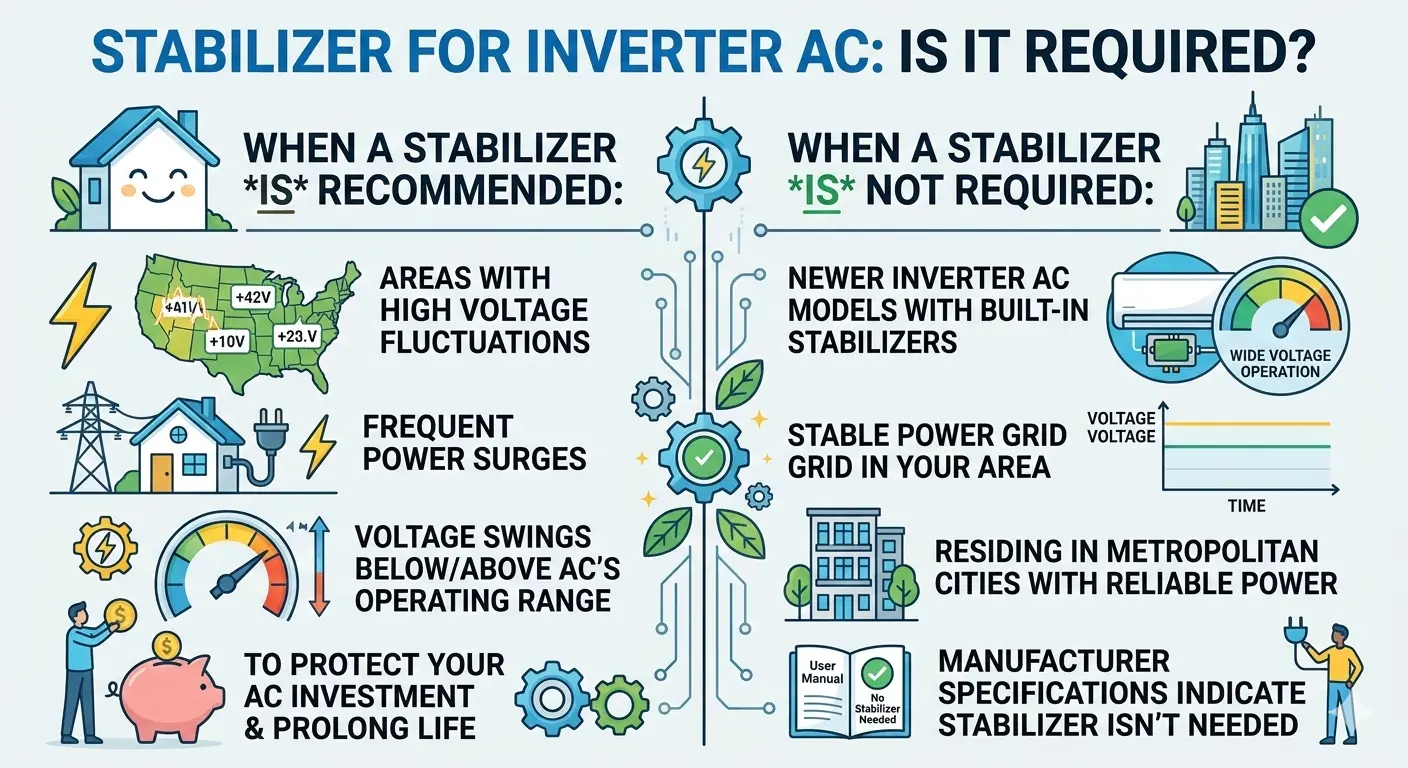
Unless your city stays in the 20s in summers, air conditioners count as essentials. If you are planning to purchase one, we assume an inverter AC would be your leading choice. However, there are several areas to consider here. The use of a stabilizer with an inverter AC is one of them.
A stabilizer helps with safe and regular voltage output to appliances. It protects them from conditions like under-voltage, high-voltage, or power surges. Managing the voltage fluctuations can protect sensitive electronics from any damage, enhance energy efficiency, and manage equipment lifespan. Clearly, an AC does require a stabilizer in general cases. Let’s see how the picture changes once you switch to an inverter AC.
Let us cut to the chase: is a stabilizer required for an inverter AC?
The answer is NO. The modern inverter AC generally does not need an external stabilizer. This is due to their in-built regulation. However, if you live in a location that faces severe or constant voltage fluctuations. If your home is old or has poor wiring issues, you need to reconsider.

Come, read this post and get a clearer picture.
How Inverter ACs Handle Voltage Fluctuations?
It is the new, advanced, and built-in circulatory system of inverter ACs that helps them manage voltage fluctuations. This is also known as stabilizer technology. Talking of their working mechanism, they do not shut down during low-voltages, as other non-inverter models do. Instead, they employ DC motors or variable-speed compressors, which keep the operations moving.
Inverter ACs have an internal electronic expansion valve (EEV). They also have a microprocessor inverter. Both of these serve as stabilizers and help adjust to irregular power supplies.
Next, let us talk about the inverter AC voltage range. These ACs are designed to function throughout multiple voltage ranges, going from 160V to up to 290V. However, there might still be a need for an external stabilizer when the fluctuations go beyond this figure. Clearly, now you you know when is a stabilizer required for an inverter AC. Let’s learn exceptions ahead!
When a Stabilizer Is NOT Required?
Fortunately, there are times you can run your air conditioner without a stabilizer. Besides, there are many benefits of not using one, such as cost and space saving, energy efficiency, and more. Here’s when you can:
Stabilised Voltage Supply
If you live in a locality that doesn’t experience frequent electricity cuts or voltage fluctuations, clearly, you don’t need a stabilizer. You can measure that by ensuring the voltage stays between 160V and 270V. However, if your air conditioner is built to manage a wide range, such as 145V–290V, it can function independently.
Built-in Protection
For air conditioners with in-built protection, or as they are called, stabilizer-free ACs, you don’t need to buy an additional one. Generally, these have high efficiency, and themselves serve as an internal protector for normal power conditions. In fact, many inverter ACs fall under this category. Similarly, many models safeguard against printed circuit boards.
When Does Your Inverter AC Need a Stabiliser?
Your inverter AC may require a stabilizer in certain situations. This is when you experience extreme or frequent voltage fluctuations, figures going below or above 160 V and 270 V. Areas with unreliable power grid or AC models without any in-built stabilizer call for an inverter air conditioner.
Additionally, large inverter AC units with more voltage instability are much more in need of an external stabilizer. This becomes necessary for the long-term stability of the equipment. Additionally, you must look for the wiring and the make of your building.
What Do AC Manufacturers Say?
Whenever purchasing any equipment, you perform several checks. You compare models from different manufacturers, check energy efficiency, models, technologies, and whatnot. Most importantly, you wonder, ‘Is a stabilizer required for an inverter AC?’
So let us answer this question while observing how different models work with or without stabilizers.
Daikin
Let us start with a leading brand that offers high-end energy efficiency, long-term savings, and advanced cooling opportunities: Daikin. But does an inverter AC by Daikin need an inverter? With Daikin, you won’t need a separate stabilizer for an inverter AC. All of the models by this brand work excellently from 160V to 264V. As a result, you can experience high efficiency with safe operations.
LG
LG is a leading brand for electronics. It promises high efficiency, quieter operations, and faster cooling for an inverter AC. But again, is a stabilizer required for an AC by LG? Just like Daikin, even LG’s inverter ACs do not need an external stabilizer as they handle voltage fluctuations from 145V to 290V.
Samsung
The technology of the digital inverter makes it much more capable of consuming less than 73% less power. Its AC models come with an S-UTR compressor that eliminates the need for any external stabilizer. Its ACs automatically manage the voltage to avoid power failure.
Panasonic
Panasonic is a leading choice for anyone looking to purchase an AC without a stabilizer. Its ACs feature an in-built stabilizer, securing a stable power supply. The ideal voltage required for these ACs goes from 100V to 290V.
Blue Star
Any equipment from Blue Star features a high energy efficiency and provides the savings of upto 65%. ACs are equipped with high-end cooling technology, such as 5 to 1 and 6-1 convertible modes. They also offer stabilizer-free operations, saving you from using a stabilizer.
Please note:
These were only a few brands of inverter air conditioners. However, if you live in an area with high-voltage fluctuations or have old wiring in your building, it is better to check in with your electrician regarding the need for a stabilizer for your AC.
Final Thoughts
This post was an answer to the most common question by AC buyers: Is a stabilizer required for an inverter AC? This was a guide for home/building owners looking to purchase an inverter air conditioner. An inverter air conditioner comes with an in-built, smart and advanced circuitry, particularly an inverter printed circuit board (PCB). These are often known as stabilizer-free air conditioners and adjust the voltage to work well with fluctuations. However, many of these are designed to work with a fluctuation range from 145V to 290 V. Besides, you also need to consider the wiring and electrical work performed in the building, along with the voltage fluctuations in your area.
Nevertheless, if you live in a location with high voltage fluctuations, do not hesitate to reach out to an electrician before installation.
Frequently Asked Questions
Can an inverter AC run without a stabilizer?
Yes, an inverter AC can function without any external stabilizer because of an in-built voltage regulation. However, an external stabilizer is still sought out when considering locations with frequent and severe voltage fluctuations.
Do you need a stabilizer for the Voltas inverter AC?
Generally, you don’t. However, if you reside in a location with high voltage fluctuations, you may need an external stabilizer for your Voltas inverter AC.
What happens if we use AC without a stabilizer?
This can bring you to an increased risk of potential damage to your equipment’s compressor and circuit board. As a result, you may experience inefficient cooling. Most modern ACs are indeed built with resilience, but changes in voltage can still invite costly repairs.
How to protect an inverter AC/PCB?
Install a voltage stabilizer to handle power fluctuations. Add a conformal coating to avoid corrosion from dirt and moisture. Most importantly, conduct regular inspection and maintenance.
What is the disadvantage of an inverter AC?
It has a high cost to begin with. Then there are more complexities with the technology that may require repair and regular maintenance. However, it’s always better to see a longer picture and compare both pros and cons before making a purchase.
Are AC stabilizers really necessary?
They are generally necessary in areas with high voltage fluctuations, frequent surges, or electricity cuts. Even though many modern air conditioning models do not have a need for stabilizers, installing one can help elongate the lifecycle of your air conditioner.
How to choose a stabilizer for an inverter AC?
You can find the right stabilizer for an air conditioner by matching its capacity, measured as KVA, with the tonnage of the AC. Also, look out for a bigger input voltage range. For example, a stabilizer for 1.5 ton AC can be of 4kVa.
Can low voltage damage an inverter AC?
Yes, it can. Low voltage requires the compressor to work harder. This can invite problems like overheating, high energy consumption, or failure of internal components ahead of their time.
What is the difference between AC and inverter AC?
An inverter AC comes with variable-speed compressors to manage cooling power. This can help you save 30-50% in electricity bills. You can enjoy consistent temperatures and quieter operations, as compared to how things were in the older models.
Does a Blue Star inverter AC need a stabilizer?
No, it comes with stabilizer-free operations.
Which brand offers the most reliable 1.5-ton split ac with inbuilt stabilizer?
As of 2026, the top models come from LG, Panasonic, and Daikin.
What is the minimum voltage required for 1.5-ton ACs?
Generally, they need a voltage of 220-240V for optimal operations. However, many models can work under low voltages and can work with 160-170V.

