



Blog
RO vs UV Water Purifier: Which One to Choose and Why?

Some purchases are actually long-term investments, and a water purifier is one of them. After all, water is essential, and so is ensuring that you consume it after removing contaminants and chemicals. But how do you pick the best one? Don’t think! Just count on our guide on RO vs UV water purifier.
UV or ultraviolet purifiers and RO or reverse osmosis are the two most popular options in the market. There has been a longstanding debate around making the best pick. Choosing the one for you requires careful consideration of the features, technologies, and approaches.
With this post, let us do that for you. Ready to discover which is better, RO or UV?
RO vs UV Water Purifier: Which One to Choose?
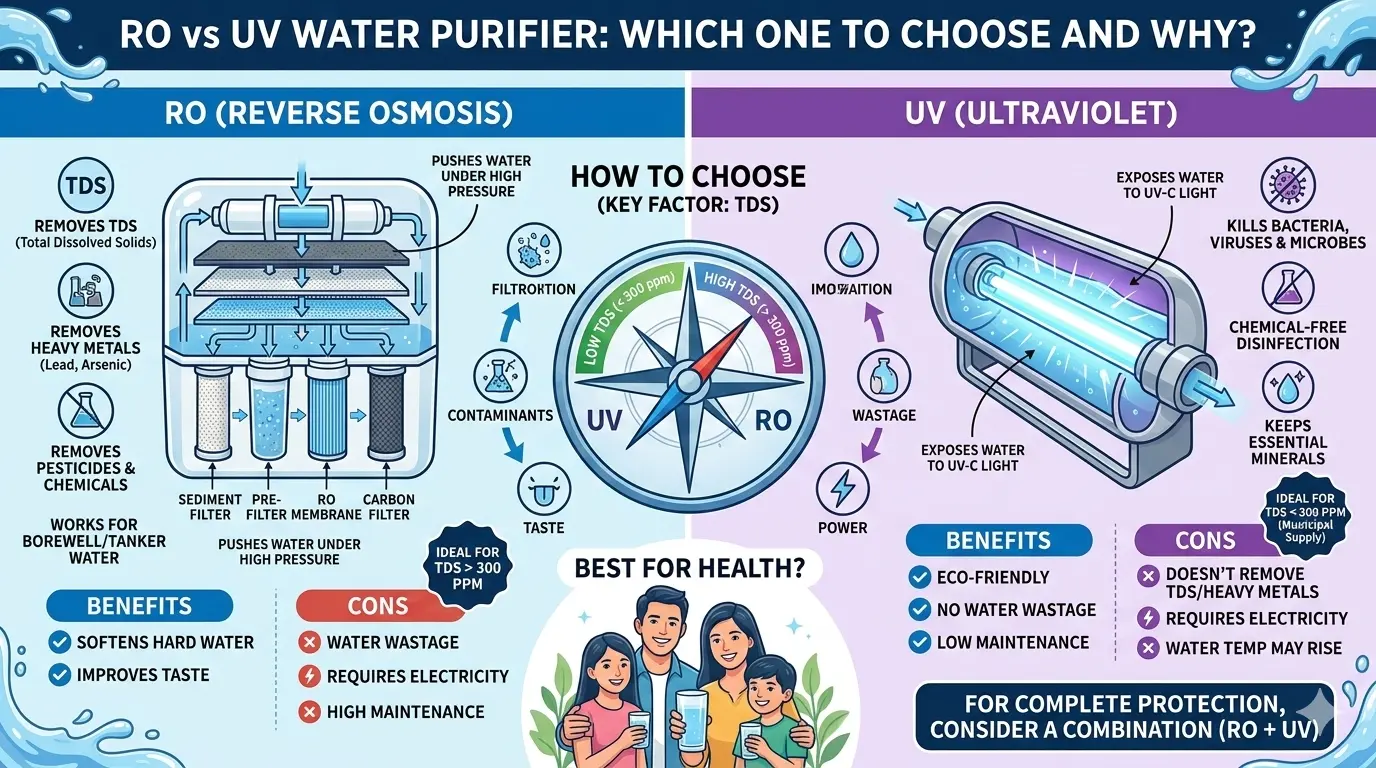
If you are waiting for a straightforward answer, there is none. That’s because it clearly depends on the total dissolved solids (TDS) level of your water source. An RO (reverse osmosis) system is ideal for water from a tanker/borewell with a high TDS (over 300ppm). An ultraviolet is ideal for water with a low TDS level (less than 300ppm).

In the coming section, let us understand the outcome of RO vs UV water purifiers in detail.
What is an RO Purifier and How Does it Work?
An RO, or reverse osmosis, is a process employing a semi-permeable membrane to remove TDS from water. It consists of a sediment filter, a pre-filter, a side-stream RO membrane, and a carbon filter.
The RO purification process used here works by pushing water under high pressure. The water molecules pass through the membrane; the larger particles, molecules and ions don’t.This process helps remove harmful contents, but that’s not all. It also turns hard water into soft water.
Benefits of RO Purifier
An RO works excellently for water purification purposes, and here are the benefits of using it:
- Effectively removes harmful contents, including lead, arsenic, and pesticides.
- Gets rid of microorganisms that reduce the possibility of waterborne diseases.
- Lowers the TDS level in water, making it ideal for areas with high TDS.
- Removes sulfur, chlorine, and other particles, leaving a fresher taste.
Cons of an RO Purifier
Here are a few things to consider about an RO purifier. It:
- Causes significant water wastage in the process.
- Lowers TDS, which might not be an advantage for areas with already lower levels.
- The low TDS may lack the nutrients necessary for the human body.
- Doesn’t effectively remove all the bacteria and purifier.
- Needs regular and costly maintenance.
What is a UV Water Filter?
Let us move to the next step of finding which is better: RO vs UV water purifier. A UV or ultraviolet water purifier employs UV light for clean drinking water. It is an easy-to-maintain filter and ensures chemical-free water. However, on the flip side, it cannot eliminate the TDS from the water. Let us tell you how this process works.
The process involves a filtration chamber where the water is exposed to UV-C or ultraviolet light. This intense light kills the bacteria and viruses, giving you cleaner water to drink.
Benefits of a UV Water Filter
In the coming section, let us talk about the benefits of using a UV filter:
- Offers effective water filtration by removing the viruses, cysts, and bacteria.
- Follows a safe process with a chemical-free removal.
- Delivers on-demand water filtration.
- Provides a reliable performance round-the-clock.
- Works with a sustainable and eco-friendly process.
Cons of a UV Water Filter
Here are some cons of UV water filter. It:
- Does not remove chlorine, dissolved chemicals, or heavy metals.
- Needs a constant supply of electricity.
- Water temperature can increase if left in the chamber for longer.
- Needs a separate sediment filter for pre-filtration.
RO Water Purifier vs UV Water Purifier: How to Choose?
In the end, it is all about choosing which is ideal: RO vs UV water purifier. The decision primarily depends on the TDS or total dissolved solids of the water source. TDS refers to the concentration of the dissolved inorganic salts and organic matter in water. These elements can include calcium, bicarbonates, magnesium, and chlorides. TDS is measured with milligram per litre (mg/L) or parts per million (ppm).
Here are some facts about TDS in water filtration and its role in understanding the difference between RO vs UV water purifiers.
- The TDS in water tell about organic and inorganic matters in the dissolved water.
- Ideally, the water worth drinking needs to have 50-300ppm as its TDS level.
- High TDS levels can indicate the presence of certain substances in the water, which can make it taste bitter, metallic, or salty.
- Water with low TDS can taste bland or flat.
Considerations for Choosing Between RO and UV Water Purifier
TDS Levels or Water Quality
The TDS levels are a major factor in determining the water purification system for your home. An RO system is ideal for places with a higher level of TDS, going above 300ppm. This can include sources of a borewell, tanker water, or dissolved salts. You can choose a UV water purifier for lower TDS levels.
Contaminants
Contaminants in the water supply have a role to play in choosing between an RO and a UV water purifier. If you want to pick an RO, choose it for water sources with viruses, bacteria, dissolved salts, and pesticides. On the other side, a UV removes the viruses and bacteria, but doesn’t get rid of the dead microbes.
Power and Water Wastage
Power and water wastage are notable parameters determining the difference between RO and UV. A reverse osmosis system works effectively but wastes water, which can be a problem for areas with scarcity. A UV doesn’t cause much water wastage and won’t take a lot of energy either.
Maintenance and Care
Care and maintenance of water is crucial, as effective functioning requires good upkeep. A reverse osmosis system can call for costly maintenance, as it regularly needs replacement of the filter/membrane. An ultraviolet, on the other hand, calls for lower maintenance, as only UV lamps need to be replaced.
Taste
You can determine which is better between RO and UV without considering the taste of the water. An RO can work well to balance the taste of salty and hard water. However, the UV doesn’t work on the taste of water.
RO vs Water Purifier: When is an RO the Ideal Choice?
If you are planning to shop for an RO for your water filtration process, consider it ideal for high TDS or sourced from tankers or borewells. If you want to improve the water taste as well, RO can be an ideal choice.
RO vs Water Purifier: When is a UV the Ideal Choice?
You should go for a UV filter if your home has low levels of total dissolved solids, at least between 300 ppm. Choose it if your main areas of focus with your water purifier are removal of viruses and bacteria over chemical contamination. It is also the ideal choice for areas with water scarcity, as it does not cause any wastage.
RO vs UV Water Purifier: A Quick Glance
| Parameter | Reverse Osmosis | Ultraviolet filter |
| Purification Method | Semipermeable Membrane | Ultraviolet Light |
| TDS | TDS above 300 ppm | TDS less than 300 ppm |
| Contaminations Removed | Heavy metals, germs, salts, fluoride | Viruses, Bacteria, and Cysts |
| Taste | Improved | Stays normal |
| Water Wastage | Occurs significantly | No water wastage |
Frequently Asked Questions
Here are some questions that haven’t been covered previously:
Which one to choose, alkaline water purifier vs Kent RO or UV water purifier?
A simple UV purifier works well for municipal water or lower TDS levels. You can pick Kent RO for contaminated water sources. You should ideally choose a combination of RO and alkaline water purifier for all-inclusive health and safety benefits.
Which one should I choose for low TDS water: RO vs UV vs UF water purifier?
A UF water filter is the best for low TDS rural water. In fact, it can work without electricity. A UV system is also ideal for low TDS levels, such as those found in municipal water.
Which water purifier is best, UV or RO?
UV purifier kills the viruses and bacteria in water, but they’re still present there. An RO purifier not just kills them but also removes them.
What are the disadvantages of a UV water purifier?
UV water purifiers are amazing for removing microbes. However, they can’t get rid of suspended dirt, heavy metals, or chemicals. They do not work well with turbid water. Besides, they need constant electricity.
What are the disadvantages of an RO water filter?
An RO water filter removes many dangerous contaminants, but there are many other disadvantages. It can even eliminate beneficial minerals, such as magnesium and calcium. It can waste 3-4 litres for every 1 litre of clean water.
Is it good to drink RO and UV water?
Yes, it is generally safe to consume water purified by reverse osmosis and ultraviolet processes. If you are using them as a combination, they can deliver comprehensive protection from both microorganisms and chemical contaminants.
Is RO safe for the kidneys?
Generally, water purified by the reverse osmosis process is safe for the kidneys, as it removes heavy metals, contaminants, and pesticides. This reduces the filtration load from the kidneys, which can help remove chronic diseases and stones.
Can we use RO without UV?
Yes, a reverse osmosis purifier can work on its own. In fact, it offers effective removal for dissolved solids, viruses, and bacteria. However, a combination of RO and UV can make the removal effective.
Which type of water purifier is best for health?
For the best outcome, it is better to choose the water filter that is a combination of RO + UV + UF + Mineraliser/Alkaline.
Does UV-UF reduce TDS?
No, the UV-UF filters do not lower the total dissolved solids from the water. They are meant to remove viruses and bacteria and eliminate suspended solids.
Which is better, Aquaguard or RO?
The answer to this can clearly depend on the water quality in your locality. A reverse osmosis system works well for high TDS by removing dissolved salts and heavy metals. An Aquaguard, on the other hand, is a brand that offers a water filtration system of different kinds (RO/UV/UF).
Is a UV water purifier good for health?
Yes, water from a UV purifier is safe for health, simply because it uses ultraviolet light to eliminate upto 99.9% of cysts, viruses and bacteria without any chemicals. A water purifier is necessary for mineral retention, natural taste, and microbiological safety.
Why choose Aquaguard RO UV water purifier?
Aquaguard is a well-recognised brand offering water filtration processes. It offers comprehensive protection, as the UV technique works to kill 99.9% of viruses and bacteria. An RO, on the other hand, works by getting rid of heavy metals and dissolved solids.
What is UV in a water purifier?
A UV or ultraviolet technology is the process of disinfection that employs germicidal UV-C light and removes upto 99.99% of dangerous bacteria, protozoa, and viruses. It doesn’t remove the particles physically but kills them by damaging their core DNA.
What is the best water purifier without RO?
If you don’t want to use a reverse osmosis filter, employ UF and UV technologies. They can work ideally for water with TDS levels less than 300 ppm. There are many more benefits of choosing them, such as the water taste remains the same with ultraviolet technology.
Conclusion: Finding the Ideal Water Purifier
The discussion about RO vs UV water purifier has come to an end officially, and it’s time we call this post a wrap. A reverse osmosis system works by removing dissolved impurities, including salts and heavy metals. This becomes an ideal solution for hard water with high TDS. It can work well to improve the taste of the water, particularly if your source is a tanker or a borewell.
On the other hand, a UV filter is ideal for soft water, such as that coming from a municipal supply. It uses UV light to remove viruses, bacteria, and cysts. It removes the microorganisms but doesn’t work well for dissolved solids. It causes no water wastage, unlike the processes with a reverse osmosis system.
However, drawing the final line about which is the best water filtration system can depend on your TDS levels and water type. For example, for water coming from a tanker or borewell or with high TDS, it is better to choose an RO. The TDS level needs to remain around 50-300 ppm, even though some sources call 500 ppm ideal. An RO process can maintain the TDS levels.
On the other hand, a UV water filtration system is your solution if you reside in a locality with low TDS levels. It is ideal if you want to ensure no bacterial risks.
In the present day, many water purifiers blend the leading purification methods. You can use a purifier offering a blend of RO+UV+UF or RO+UV for ideal protection against microbes and dissolved contaminants.
Remember that both of the water purification systems need cartridge and filter changes. However, for an RO system, more elements require servicing.

